Pulling up at the Swannery gates last night we were greeted by a few 'seeps' from overhead Yellow Wagtails. Speculation arose that perhaps a catch of thirty or so birds was on the cards that night.
Walking out to unfurl the nets a Black tern flew overhead at Helen's Hide and made for the round-up area but was quickly lost to view. An omen for sure!
Soon the Yellow Wagtails started to arrive along with the Swallows and Sand Martins. We quickly picked up a few Sedge and Reed Warblers and a late evening Garden Warbler was trapped in the withy bed. There is a certain cut off point in the light when the birds say 'that is it 'and go in to roost.
Luke and I had our work cut out for twenty minutes. In total 87 Yellow Wagtails, 1 Grey-headed Wagtail (nice bird) and a couple of Pied Wagtails for good measure. A handful of Swallows and Sand Martins - including a control Swallow.
A good evening. Hopefully going for more Yellow Wagtails this week if weather is kind. We are keen to surpass last years total.
Saturday, 1 September 2012

Wednesday, 29 August 2012
They're back!
After getting concerned about the lack of Yellow Wagtals at the site- only 2 observed till start of this week last night the nets were set for a roost and 9 were caught from about the 30 birds present along with a good number of Swallows and odds and ends in the withy bed.. We were joined by a member of the Axe Estuary Ringing Group who wanted some experience with roost ringing ( and also the chance of yellow wagtails). Despite the light breeze the evening proved successful with two pied wagtails also caught and colour ringed. The Pied Wagtail roost is slowly building up now.

An early morning session at the end of last week was brought to a sudden halt when from nowhere it rained. Just as things were picking up at 61 birds. The best bird was the first one out of the net at first light - a Grasshopper Warbler. Sedge Warbler fat scores usual for juvs at about 20 and the few adults caught heavy with 50.


An early morning session at the end of last week was brought to a sudden halt when from nowhere it rained. Just as things were picking up at 61 birds. The best bird was the first one out of the net at first light - a Grasshopper Warbler. Sedge Warbler fat scores usual for juvs at about 20 and the few adults caught heavy with 50.

Weather looks grim for this evening but end of the week looks promising with high pressure and low winds- at the moment anyway!
Monday, 13 August 2012
Not dead yet!
Luke apologies for a month off line I can only grovel for what must seem like an eternity. After the preparation of the site for CES the season kicked off very badly weatherwise and after a couple of aborted sessions I decided to pull the plug on CES this year. The weather was dreadful week after week and the conditions underfoot in the reeds were up to the top of, and indeed over, the waders. Not ideal ringing conditions and sinking in further each time you walked the net line. The water is still top of wader height!
The decision to pull out this year was not taken lightly but for safety issues alone looking back it was the right decision, However we are on track for completing the final 4 CES visits which can make a contribution to CES. So we have moved the net to higher ground and carried on. Reeds in water produce better catches so with the net out of the water but surrounded both sides we will see how the rest of the season goes
Two catches this month have been made to date but it is certain far fewer sedge warblers are about and nearly all the young sedge and reed warblers caught have growth bars on the tail.
Sedge Warblers are the bread and butter of Abbotsbury Swannery.
Last night we tried a test run for Swallow and Yellow Wagtail roosts. The nets seem in a good position and perfect reed height for a good catch. A very quick sample of 50 odd Swallows and 10 Sand Martins was enough and the nets shut down to avoid being swamped as over 700 Swallows were present. Ringing discipline essential on nights like that
A delightful Reed Bunting was caught this morning in moult. Attractive birds which I am still convinced have a moult pattern of their own!


The decision to pull out this year was not taken lightly but for safety issues alone looking back it was the right decision, However we are on track for completing the final 4 CES visits which can make a contribution to CES. So we have moved the net to higher ground and carried on. Reeds in water produce better catches so with the net out of the water but surrounded both sides we will see how the rest of the season goes
 |
| The repositioned net run |
Sedge Warblers are the bread and butter of Abbotsbury Swannery.
 |
| Adult Sedge Warbler |
A delightful Reed Bunting was caught this morning in moult. Attractive birds which I am still convinced have a moult pattern of their own!


Hopefully will be trying a few more roosts this week and mid week winds are south east. Aquatic time- have to catch up the guys in Cornwall!!
Thursday, 22 March 2012
Swannery update
Over the past two days habitat management at the CES site has taken place. The most important side of this is the regular coppicing of the withy bed. Important to keep the vegetation height down - nothing over three metres and also to prolong the life of the sallow and willow stools. A further beneift is the flooding of light into the ground around the stools which promotes plant growth and provides opportunities for nesting birds.
To further enhance the condition of the reed beds certain areas of reed have been cut by the Swannery staff. This promotes good healthy new growth. Some years the reed is burnt after cutting and this removes all the rubbish at the base of the reed bed and helps maintain a good healthy environment.
Of course during all this work the nets were opened where they could be. The first Chiffchaffs have been trapped for the year and also a few odds and ends. Just on finishing a Blue Tit was extracted from the net- a fine male with an interesting plumage variation. Clearly it had been visiting nearby daffodil flowers.


During the coppicing considerable evidence was found of the presence of the Lunar Hornet Clearwing moth. In one instance the saw just missed this larva stage
Whilst working on another stool a fabulous excavation was seen
Over the next few days the CES site will be brought back to optimum conditions with the usual annual management. Then we will be ready for the returning Reed and Sedge Warblers in the reeds and the more usual fare in the withy bed.
 |
| Coppiced sallow and willow stools |
To further enhance the condition of the reed beds certain areas of reed have been cut by the Swannery staff. This promotes good healthy new growth. Some years the reed is burnt after cutting and this removes all the rubbish at the base of the reed bed and helps maintain a good healthy environment.
 |
| Recently cleared reed bed |
Of course during all this work the nets were opened where they could be. The first Chiffchaffs have been trapped for the year and also a few odds and ends. Just on finishing a Blue Tit was extracted from the net- a fine male with an interesting plumage variation. Clearly it had been visiting nearby daffodil flowers.
 |
| The first Chiffchaff of the year |


During the coppicing considerable evidence was found of the presence of the Lunar Hornet Clearwing moth. In one instance the saw just missed this larva stage
 |
| Lunar Hornet Clearwing larva in situ |
Whilst working on another stool a fabulous excavation was seen
 | ||
| Larva excavation |
Over the next few days the CES site will be brought back to optimum conditions with the usual annual management. Then we will be ready for the returning Reed and Sedge Warblers in the reeds and the more usual fare in the withy bed.
Sunday, 19 February 2012
A wagtail diversion
Although not all Abbotsbury Swannery there has been a recent interest in the wagtail project. Diane, a local wagtail enthusiast, forwarded some recent photographs of birds seen in Weymouth an then a recent email from Jack Winspear regarding a wagtail sighted at Sutton Poyntz kick started the wagtail project.
This was followed by a welcome telephone call from Matt at the Weymouth Port to say that the wagtail roost had returned to the harbour. The roost had moved earlier this winter and could not be found. The returning roost at the harbour presented a challenge to set a net but on the past two evenings nearly 40 birds have been caught including two retraps from previous years.
Recent birds have been colour ringed with full colour rings as below

Previous colour rings involved bicoloured rings which were not easy to see in the field. As shown below on the retrapped bird this evening.

Details of recent colour marked birds are;
L055800 ringed Weymouth Harbour 6th Feb 2010 and sighted at Sutton Poyntz 15th Feb 2012
L055761 ringed Weymouth Harbour 1st Feb 2010 and retrapped there 19th Feb 2012
L041798 ringed Weymouth Harbour 28th Dec 2009 and sighted in Weymouth Town 15th Feb 2012
X889811 ringed Abbotsbury Swannery 23rd Sept 2009 and sighted in Weymouth Town 15th Feb 2012
X889921 ringed Abbotsbury Swannery 12th Oct 2009 and retrapped at Weymouth Harbour 17th Feb 2012
X108053 ringed Abbotsbury Swannery 5th Aug 2011 and sighted in Weymouth Town 15th Feb 2012
Do keep a lookout when out and about please.
This was followed by a welcome telephone call from Matt at the Weymouth Port to say that the wagtail roost had returned to the harbour. The roost had moved earlier this winter and could not be found. The returning roost at the harbour presented a challenge to set a net but on the past two evenings nearly 40 birds have been caught including two retraps from previous years.
Recent birds have been colour ringed with full colour rings as below

Previous colour rings involved bicoloured rings which were not easy to see in the field. As shown below on the retrapped bird this evening.

Details of recent colour marked birds are;
L055800 ringed Weymouth Harbour 6th Feb 2010 and sighted at Sutton Poyntz 15th Feb 2012
L055761 ringed Weymouth Harbour 1st Feb 2010 and retrapped there 19th Feb 2012
L041798 ringed Weymouth Harbour 28th Dec 2009 and sighted in Weymouth Town 15th Feb 2012
X889811 ringed Abbotsbury Swannery 23rd Sept 2009 and sighted in Weymouth Town 15th Feb 2012
X889921 ringed Abbotsbury Swannery 12th Oct 2009 and retrapped at Weymouth Harbour 17th Feb 2012
X108053 ringed Abbotsbury Swannery 5th Aug 2011 and sighted in Weymouth Town 15th Feb 2012
Do keep a lookout when out and about please.
Tuesday, 24 January 2012
Luke scores.............
As Luke has mentioned on his blog earlier this week we finally caught a Woodcock this winter. The conditions were almost tropical. It was +10C as we wandered around the water meadows. No crunching about in the frosty grass and no rock hard mud. A few more pictures of these magnificent birds. They really are a treat to have in the hand.


We always ring and process the birds over the net. That way you do not walk off afterwards leaving the pliers or the rings in the grass in the dark. A tidy way to work and cost effective. A colder weekend is forecast so hopefully Luke and his net will work up some more magic!


We always ring and process the birds over the net. That way you do not walk off afterwards leaving the pliers or the rings in the grass in the dark. A tidy way to work and cost effective. A colder weekend is forecast so hopefully Luke and his net will work up some more magic!
Saturday, 7 January 2012
Another painful morning!
The first calm morning this year was not wasted. An invitation to Doug from the Axe Estuary Ringing Group to join in proved to be a useful morning. No exotics and the woodpeckers were there but they turned shy on seeing my guest. Even the Treecreepers teased us by feeding on the trees adjacent to the nets but not actually connecting with them.
Plenty of Blue and Great Tits at the feeders and also good numbers of Greenfinchs. A small highlight was trapping one of Lukes Greenfinchs from nearby Clouds Hill.
A couple of Goldfinch were also trapped. Not too many of these are trapped at the Swannery so these were a couple of good birds for the morning.
The morning ended assisting Dave with feeding the Mute Swans. Pochard and Tufted gleamed in the morning sunshine. Following on from this 'duck' link is the visit to Seaton Sunday morning when the next cannon net session will take place. Luke and I are hoping for Godwits but expect Shelduck will prevail. At least they have blunt bills!
Plenty of Blue and Great Tits at the feeders and also good numbers of Greenfinchs. A small highlight was trapping one of Lukes Greenfinchs from nearby Clouds Hill.
 | ||
| Blue Tit joining in where the last woodpecker left off! |
 | |
| Even the Great Tit joined in! |
 |
| A placid Dunnock |
A couple of Goldfinch were also trapped. Not too many of these are trapped at the Swannery so these were a couple of good birds for the morning.
 |
| Male Goldfinch |
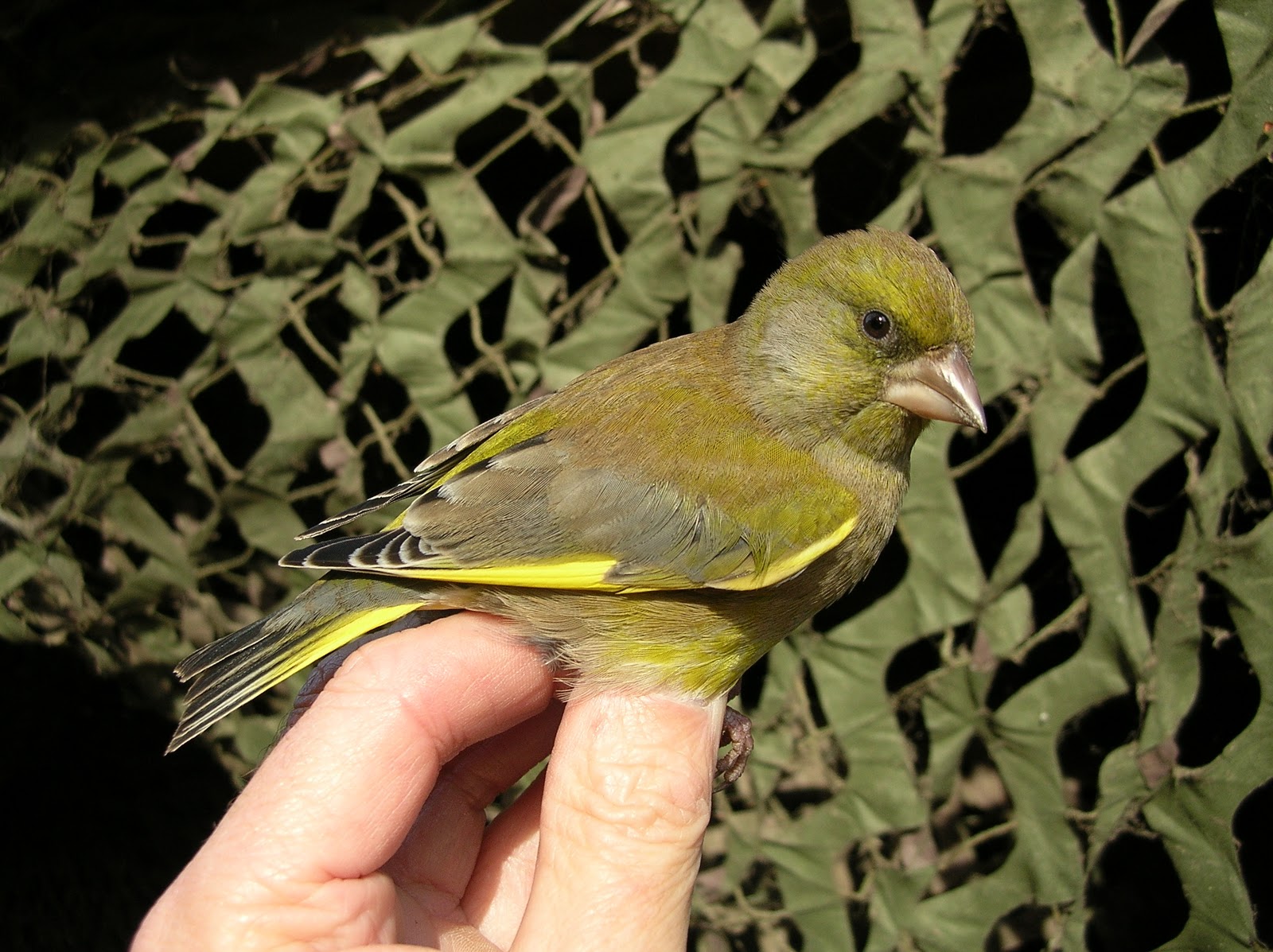 |
| Male Greenfinch |
The morning ended assisting Dave with feeding the Mute Swans. Pochard and Tufted gleamed in the morning sunshine. Following on from this 'duck' link is the visit to Seaton Sunday morning when the next cannon net session will take place. Luke and I are hoping for Godwits but expect Shelduck will prevail. At least they have blunt bills!
Subscribe to:
Posts (Atom)